

For nearly fifty years, silica-and-alumina borosilicate composite tiles have dominated reentry thermal protection. The Space Shuttle’s FRCI-12 tiles flew from 1981 until 2011, replacing the earlier LI-900 silica tiles as those failed, and vehicles from SpaceX and Sierra Space use tiles based on the same technology today.
These micro-structured tiles are low in density, low in thermal conductivity, and highly temperature-tolerant, a combination that has justified their cost, which typically runs over $1,000 per square foot. As the new space economy scales, vehicle size, mission count, and reuse cycles are all climbing, and the pressure on commercial and military designers to cut cost and raise performance is climbing with them. X-FOAM is a new option: a stiff, machinable silicon-oxycarbide ceramic foam that matches most or all of the functional parameters of traditional tiles at a much lower price point.
| Parameter | FRCI-12 | X-FOAM |
|---|---|---|
| Thermal conductivity | 0.052 W/m·K | 0.034 W/m·K |
| Density | 0.19–0.23 g/cc | 0.15 g/cc |
| Max operating temp. | 1300–1325 °C | 1300 °C |
| Compressive / flex strength | 145 PSI | 250 / 170 PSI |
| Machinability | Friable | CNC / lathe / saw |
| Cost per ft² (at scale) | $1,500–3,000 | ~$700 |
01What X-FOAM is
X-FOAM is designed and manufactured in the USA using polymer-derived ceramic technology. A proprietary resin is combined with catalysts and foamed into a homogeneous plastic, cured solid, then pyrolyzed in an oxygen-free furnace, where it transforms into an amorphous silicon oxycarbide (SiOC) ceramic.
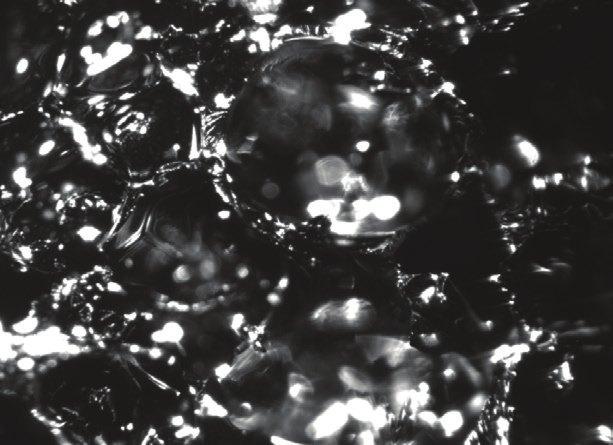
The result is a hard, strong, black ceramic whose foam cells are typically half-open and half-closed and smaller than a millimeter. Because the ceramic is amorphous rather than crystalline, its thermal conductivity runs 10 to 20 times lower than crystalline ceramics of the same family. The foam is extremely stiff, holds a sharp edge, does not crack during machining, and can be produced across a range of densities and pore sizes.
02Cost
In 2010, NASA estimated that a 6-by-6-by-1-inch tile cost roughly $1,000 to procure in quantity, which scaled to about $1,000 to $2,500 per square foot in 2010 dollars, on the order of $3,000 per square foot today. Modern methods might bring that back toward $1,500 per square foot.
X-FOAM’s vertical integration, from resin components through green-state manufacturing and furnace processing, allows a much lower cost per tile. At moderate mass-production volumes, a 6-by-6-by-1-inch X-FOAM tile costs under $380, roughly $1,100 per square foot. At full mass production the price can fall to around $700 per square foot, a saving of over 50% before the further savings in machining, handling, installation, and refurbishment.
03Thermal conductivity
The room-temperature thermal conductivity of FRCI-12 is 0.052 W/m·K, a figure that served the Shuttle program well across more than a hundred missions. X-FOAM measures 0.034 W/m·K, only about 1.5 times the conductivity of air at room temperature.
Two properties drive that number: the amorphous SiOC structure and the foam’s 90 to 95% porosity. In crystalline materials, ordered rows of atoms let vibrational energy (phonons) travel efficiently. X-FOAM has no long-range order, so those channels do not exist, and heat has a much harder time moving through the material. Further testing is underway to characterize conductivity across a wider temperature range.
04Operating temperature
The long-term operational limit of RCG-coated borosilicate tiles is generally assessed at about 1,300 to 1,325°C. Elon Musk has stated that SpaceX tiles were tested as high as 1,375°C, though for short-term, non-operational exposure.
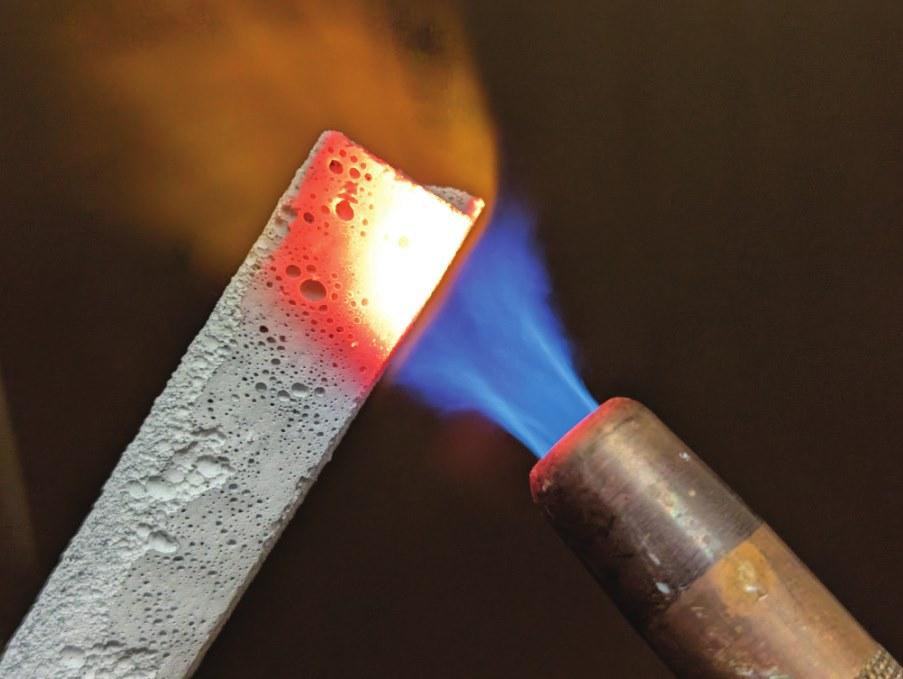
X-FOAM is guaranteed to 1,300°C and holds its shape as it slowly transforms toward foamed silica (cristobalite) above 1,400°C. In propane torch testing, pieces held roughly 1,900°C surface impingement for one minute with no apparent degradation. Held at 1,300°C for four hours in air, X-FOAM stayed fully amorphous by X-ray diffraction and lost only 0.3% of its mass. In furnace testing from 1,300 to 1,600°C in 100°C steps, four hours at each temperature, total mass change was just 0.15%.
05Vacuum stability
There is no recorded vacuum testing of FRCI-type tiles, since they are outward-facing. X-FOAM has passed ASTM E595 vacuum outgassing testing, with no solvents or components measured to volatilize across its operating range. Outgassing does not matter for outward-facing tiles, but it does for encapsulation and for insulation around avionics, and X-FOAM is a candidate for both.
06Stiffness and strength
FRCI-12 has a uniaxial compressive strength of about 145 psi and a tensile strength near 76 psi, and it is anisotropic, so its strength differs by axis. X-FOAM is isotropic, with the same strength in every direction: about 250 psi in compression and 170 psi in a three-point flexure test for the 0.15 g/cc version. It is mechanically stronger than typical FRCI-like tiles and needs less lateral support. Denser X-FOAM variants reach potentially useful strengths above 1,000 psi.
07Machinability
FRCI-like tiles cut like soft chalk because of their high porosity, and their friable edges chip easily. Machining produces a fine silica dust that is easy to inhale, which makes shaping them an almost artisanal process.
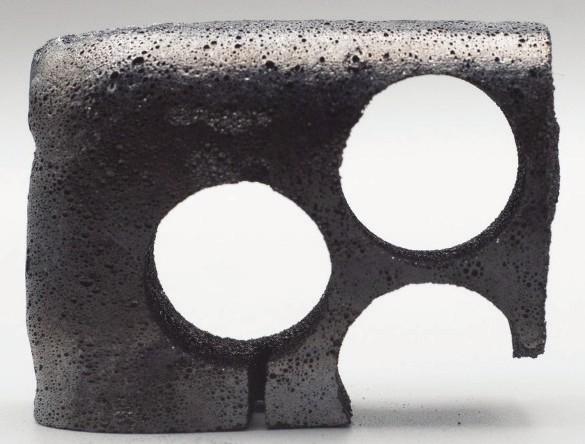
X-FOAM is also easy to cut, but far stiffer. Edges hold strongly, even with small holes, thin cuts, and sharp corners. Band saws, drills, and hacksaws all work, and lathes and CNC machines cut it exceptionally well with no lubrication or cooling. The particles produced are dark, glassy, and chemically inert, roughly 50 to 200 microns in size. Masks and eye protection are recommended, but no special handling or disposal is required. The result is high-volume, highly repeatable machining.
08Waterproofing
Tiles sit outdoors on the side of a vehicle, exposed to rain, condensation, and humidity. The RCG coating on FRCI-like tiles is a good rain shield when pristine, but CTE mismatch, thermal stress, and launch vibration open small cracks in the glass, and moisture then seeps into the hydrophilic substrate. The Shuttle program injected waterproofing through the glass, but those silanes burned away near 1,050°C, so the injection had to be repeated for every flight, a costly operation that is infeasible for rapid commercial reuse.
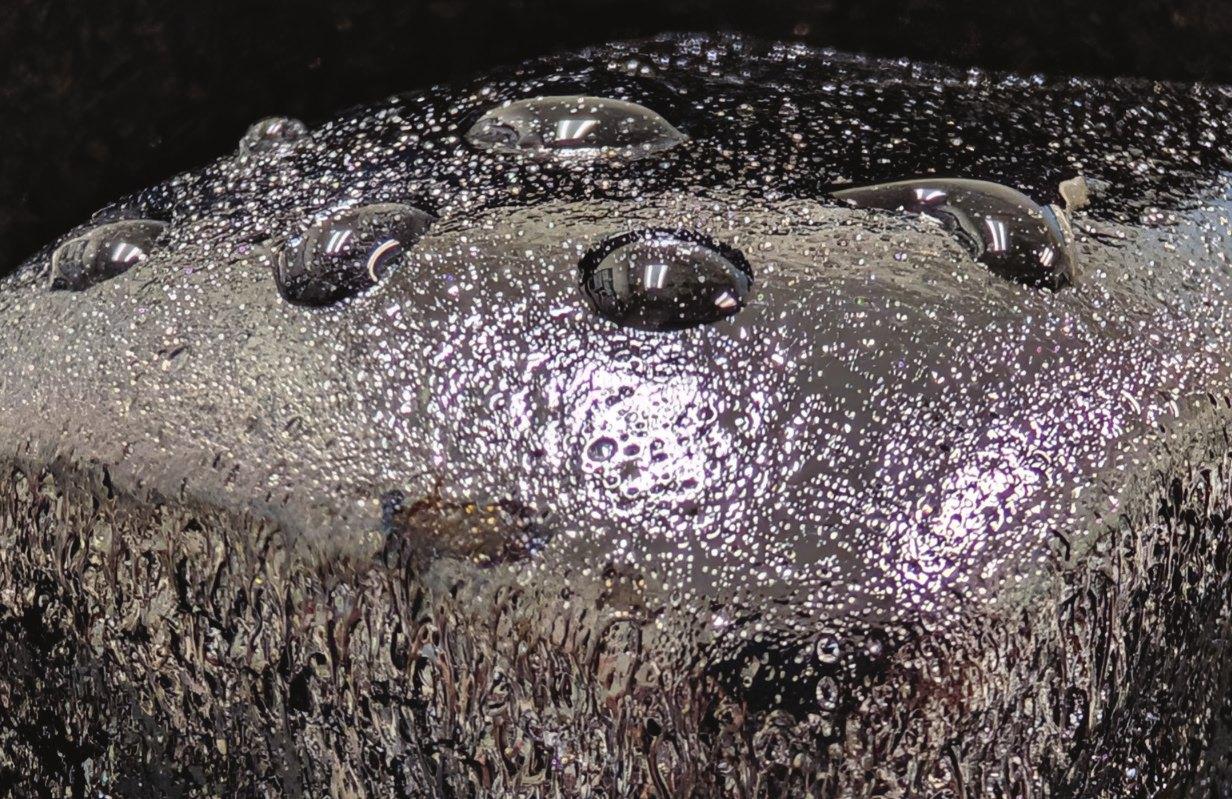
X-FOAM can be produced in its green state with a thin outer seal over every surface, glassy and made from the same material as the bulk foam. Because the seal is inherently part of the piece, there is minimal CTE mismatch and it does not easily crack or delaminate. It is also far thinner than RCG, on the order of 10 microns, so the added mass is negligible. The seal protects the tile from launch-pad moisture and generally requires no refurbishment before the next mission.
09Conclusion
X-FOAM offers a new alternative to silica-and-alumina borosilicate tiles for aerospace thermal protection. Its weight, thermal insulation, and maximum operating temperature are comparable to FRCI tiles, while its stiffness, machinability, emissivity, and waterproofing are superior. Most importantly, X-FOAM is much less expensive, offering material savings of better than 50% before the additional savings across the tile’s life. As a new aerospace material it warrants further testing with partners, and we welcome those conversations.